- Call: 1 825 454 8883
- Email: learnersgain@gmail.com

Instructor: Claire Shaun
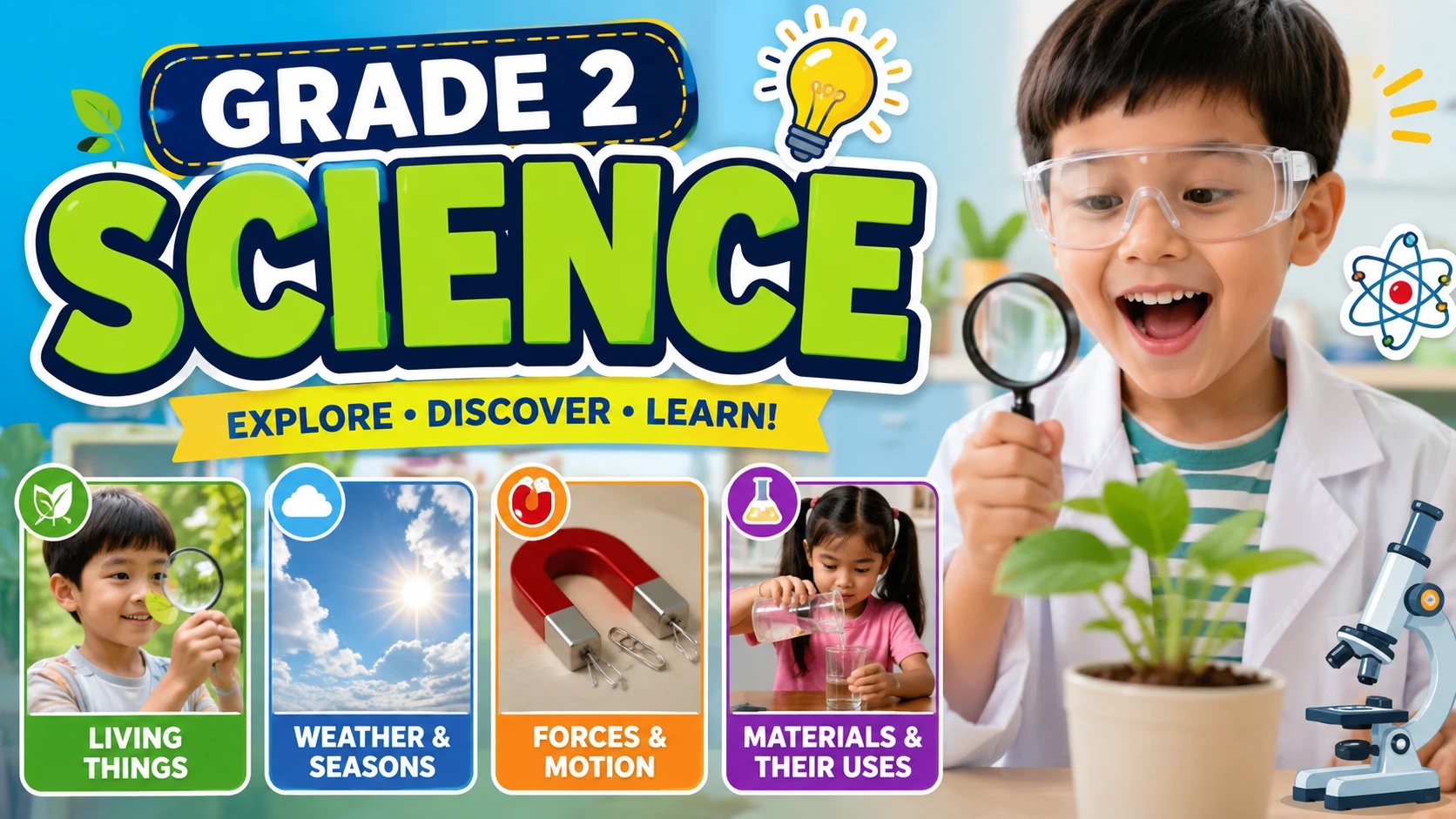
WELCOME TO GRADE 2 SCIENCE
Grade 2 Science on Learners Gain introduces young learners to the exciting world of scientific discovery. This course helps students understand that science is not just about facts — it is about observing, asking questions, investigating, recording information, and sharing what they learn.
Through engaging, age-appropriate lessons, learners explore important science topics such as what scientists do, living and nonliving things, plant needs and growth, animals and their needs, habitats around the world, weather and temperature, and states of matter. Each lesson is designed to build curiosity, critical thinking, and confidence while helping students connect science to everyday life.
Students will learn how to identify plant and animal needs, compare habitats, observe weather patterns, read simple temperature information, and recognize solids, liquids, and gases. They will also practice using science vocabulary, completing simple observations, sorting objects, drawing diagrams, answering quizzes, and doing home practice activities.
This Grade 2 Science course supports hands-on learning through worksheets, observation tasks, quizzes, practical activities, and family-friendly home connections. It encourages learners to think like young scientists by noticing details, asking meaningful questions, and explaining their ideas clearly.
By the end of the course, students will have a stronger understanding of the natural world and the basic science skills needed for future learning.
0 Reviews


⭐ INTRODUCTION Chemistry 20 explores how matter behaves, how atoms bond, how reactions occur, and how energy flows through chemical systems. Students learn the foundational concepts needed for Chemistry 30, university chemistry, and real‑world applications in medicine, engineering, and environmental science.

⚡ PHYSICS 20 — INTRODUCTION Physics 20 explores the fundamental principles that govern motion, forces, energy, and momentum. Students learn how objects move, why they move, and how energy flows through physical systems. Through real‑world applications, hands‑on problem solving, and clear conceptual models, learners build a strong foundation for advanced physics, engineering, and STEM pathways. This course emphasizes critical thinking, mathematical reasoning, and scientific inquiry while connecting physics concepts to everyday life.

Introduction — Biology 20 Biology 20 explores how living systems obtain, use, and transfer energy. Students investigate human physiology, ecological relationships, photosynthesis, cellular respiration, and population dynamics. This course builds the scientific reasoning and analytical skills needed for Biology 30.