- Call: 1 825 454 8883
- Email: info@learnersgain.com


Instructor: Claire Shaun
Physics 20 is designed to help students understand the physical laws that shape our world — from the motion of vehicles on a highway to the forces acting on a falling object, from the energy stored in a stretched spring to the momentum exchanged during a collision. This course builds a deep conceptual and mathematical understanding of how and why objects move, interact, and transform energy.
Students will explore four major areas of physics:
Learners investigate how objects move in one and two dimensions. They analyze displacement, velocity, acceleration, and motion graphs, and apply vector principles to real‑world scenarios such as projectiles and relative motion.
Students examine the causes of motion. They learn how forces interact, how friction affects movement, and how Newton’s Laws explain everything from walking to rocket launches. Free‑body diagrams become essential tools for analyzing physical systems.
This unit explores how energy is stored, transferred, and transformed. Students calculate work, kinetic and potential energy, and power, and apply the law of conservation of energy to mechanical systems.
Learners study momentum, impulse, and collision types. They apply conservation laws to real‑world contexts such as vehicle safety, sports impacts, and physics‑based engineering design.
Welcome to Physics 20 — a course built to spark curiosity, strengthen analytical thinking, and empower students to understand the physical world with confidence. This curriculum emphasizes clarity, real‑world relevance, and hands‑on exploration. Each lesson includes diagrams, examples, practice problems, worksheets, quizzes, and answer keys to support both teachers and learners.
Physics is not just about equations — it is about discovering patterns, predicting outcomes, and understanding the invisible rules that govern everything around us. As you guide students through this course, encourage them to ask questions, explore ideas, and connect physics concepts to everyday experiences.
Together, we will build a strong foundation for future studies in physics, engineering, technology, and the sciences.
0 Reviews


⭐ INTRODUCTION Chemistry 20 explores how matter behaves, how atoms bond, how reactions occur, and how energy flows through chemical systems. Students learn the foundational concepts needed for Chemistry 30, university chemistry, and real‑world applications in medicine, engineering, and environmental science.

Introduction — Biology 20 Biology 20 explores how living systems obtain, use, and transfer energy. Students investigate human physiology, ecological relationships, photosynthesis, cellular respiration, and population dynamics. This course builds the scientific reasoning and analytical skills needed for Biology 30.
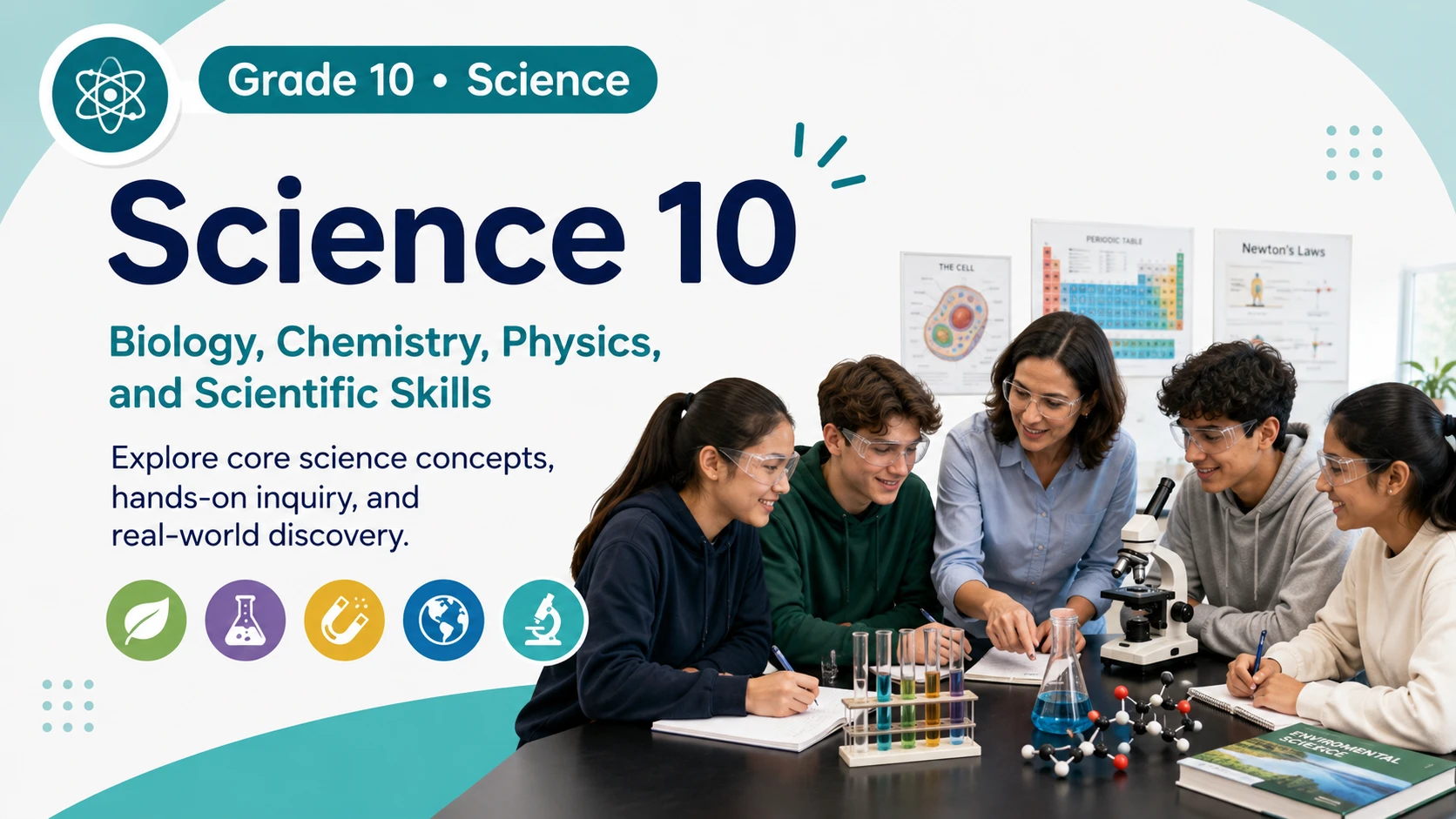
INTRODUCTION TO SCIENCE 10 Science 10 is an integrated exploration of the living world, the physical world, and the chemical world. Through Biology 10, Chemistry 10, and Physics 10, students build foundational scientific literacy, develop problem‑solving skills, and learn how natural systems interact. This course prepares learners for advanced sciences by strengthening inquiry, experimentation, and critical thinking.