- Call: 1 825 454 8883
- Email: learnersgain@gmail.com

Instructor: Claire Shaun
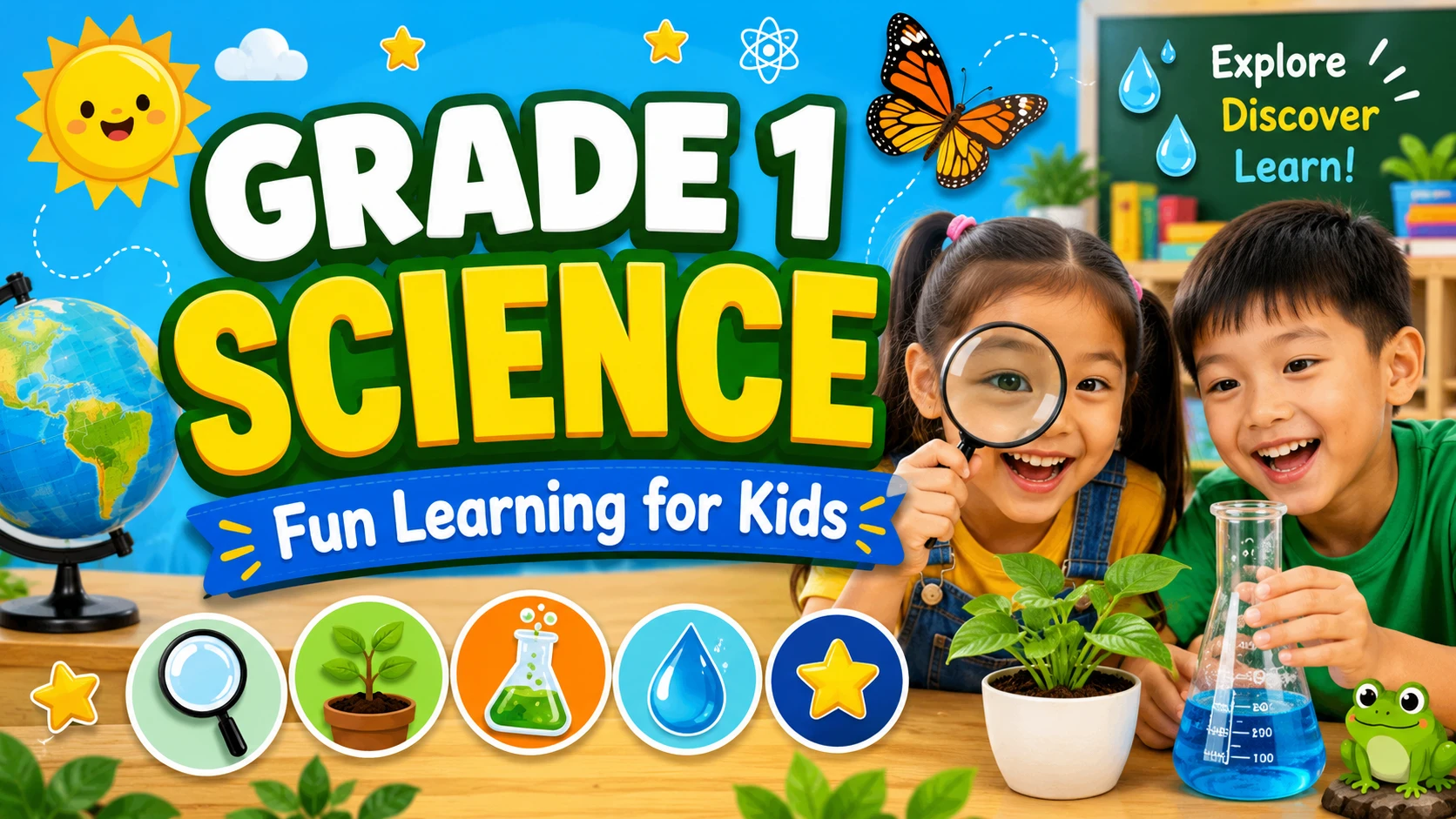
The Grade 1 Science course on LearnersGain is designed to help young learners build curiosity, observation skills, and a strong foundation in science. Through simple explanations, colourful examples, and engaging activities, students will discover how the world around them works.
This course introduces children to important science topics such as living and non-living things, plants and animals, the human body, the five senses, weather, seasons, materials, objects, and simple changes in the environment. Learners will be encouraged to ask questions, make observations, compare objects, describe what they see, and connect science to everyday life.
Each lesson is created in a child-friendly way to make learning easy, fun, and meaningful. Students will practise identifying, sorting, describing, and explaining basic science ideas while building confidence for future learning.
By the end of this course, learners will be able to:
Understand the difference between living and non-living things
Identify basic needs of plants, animals, and humans
Describe simple weather patterns and seasons
Recognize the five senses and parts of the body
Compare materials and everyday objects
Observe, ask questions, and explain simple science ideas
Develop curiosity and confidence in learning science
This course is perfect for Grade 1 students, parents, and teachers looking for a clear, engaging, and age-appropriate science program that supports early learning at home or in the classroom.
0 Reviews

⭐ INTRODUCTION Chemistry 20 explores how matter behaves, how atoms bond, how reactions occur, and how energy flows through chemical systems. Students learn the foundational concepts needed for Chemistry 30, university chemistry, and real‑world applications in medicine, engineering, and environmental science.

⚡ PHYSICS 20 — INTRODUCTION Physics 20 explores the fundamental principles that govern motion, forces, energy, and momentum. Students learn how objects move, why they move, and how energy flows through physical systems. Through real‑world applications, hands‑on problem solving, and clear conceptual models, learners build a strong foundation for advanced physics, engineering, and STEM pathways. This course emphasizes critical thinking, mathematical reasoning, and scientific inquiry while connecting physics concepts to everyday life.

Introduction — Biology 20 Biology 20 explores how living systems obtain, use, and transfer energy. Students investigate human physiology, ecological relationships, photosynthesis, cellular respiration, and population dynamics. This course builds the scientific reasoning and analytical skills needed for Biology 30.