- Call: 1 825 454 8883
- Email: info@learnersgain.com
By Admin
Getting children to read for pleasure has become more challenging than ever.
Books now compete with smartphones, tablets, streaming platforms, video games, social media, and endless short-form videos designed to capture attention in seconds.
For many parents, this creates a frustrating question:
“How do I get my child to choose a book when a screen is always more exciting?”
The answer is not necessarily to remove technology completely.
Children are growing up in a digital world, and technology can be useful for learning, creativity, communication, and entertainment. The goal is to help children develop a healthy relationship with screens while also discovering that reading can be enjoyable, exciting, relaxing, and rewarding.
A voracious reader is not simply a child who completes assigned reading.
It is a child who becomes curious about books, stories, information, ideas, and new worlds.
And that love of reading can be developed.
Here are practical ways parents can help children become enthusiastic readers, even in a world filled with digital distractions.
Children are more likely to value reading when they see that reading is a normal part of life.
If the only time a child encounters a book is when a teacher assigns one, reading can begin to feel like homework.
Instead, make books visible and accessible at home.
Keep reading materials in places where children naturally spend time.
This might include:
Books beside the bed
A small basket of books in the living room
Magazines on a table
Comics in a reading corner
Cookbooks in the kitchen
Library books in an easy-to-reach place
The goal is to make reading feel available rather than forced.
Even ten or fifteen minutes of regular reading can help establish a habit.
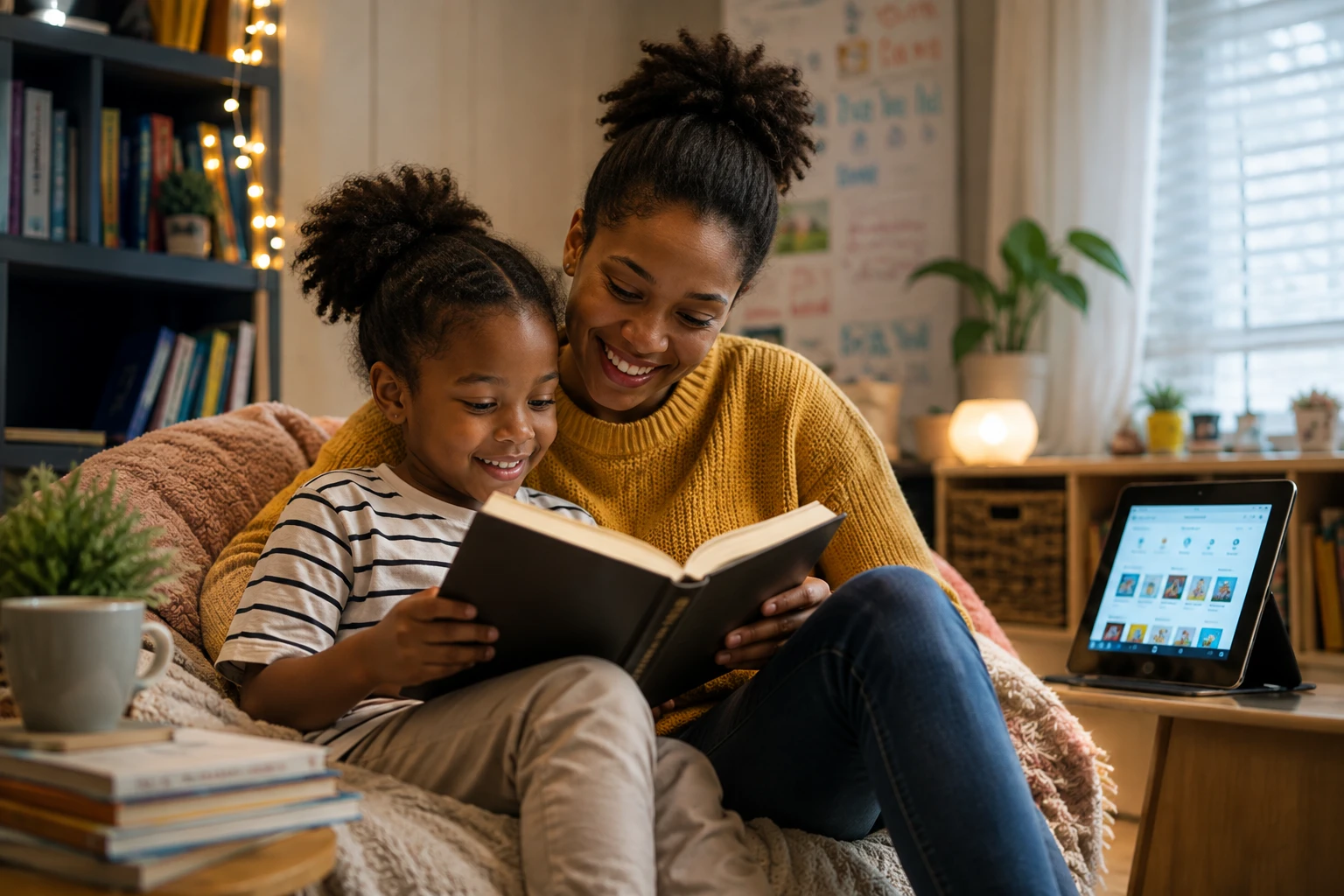
Younger children may enjoy reading with a parent before bed.
Older children may prefer quiet independent reading in the evening.
Consistency matters more than making every reading session long.
One of the fastest ways to make reading feel like a chore is to control every book a child reads.
Parents naturally want children to read challenging and educational material.
But reading for pleasure is also important.
A child may prefer:
Mystery stories
Fantasy
Adventure
Graphic novels
Comics
Sports books
Biographies
Science books
Animal stories
Humour
History
Technology
Short stories
Magazines
The goal is to get the child reading.
A child who enthusiastically reads a graphic novel is still practising vocabulary, comprehension, inference, sequencing, and interpretation.
A child who loves reading about dinosaurs may eventually become interested in biology.
A sports fan who reads player biographies and statistics is still building literacy skills.
Interest creates motivation.
Instead of asking:
“What book should my child be reading?”
also ask:
“What would my child genuinely enjoy reading?”
It can be tempting to blame smartphones and tablets for every reading problem.
But simply declaring screens “bad” and books “good” may create unnecessary conflict.
Technology can also support reading.
Children can use devices to:
Read e-books
Listen to audiobooks
Look up unfamiliar words
Research topics they discover in books
Access digital libraries
Read educational articles
Explore interactive stories
The key is balance.
Parents can create clear expectations around recreational screen time while still allowing technology to support learning.
For example:
Homework first.
Reading time next.
Then recreational screen time.
The exact routine will depend on the family.
The important thing is ensuring that entertainment screens do not automatically fill every free moment.
Children often struggle to concentrate when a phone or tablet is constantly nearby.
Even the possibility of a notification can become distracting.
Consider creating short periods when devices are put away.
For example:
20 minutes after dinner
30 minutes before bedtime
Weekend morning reading
A family reading hour
During this time, everyone can read something they enjoy.
Parents can read too.
The experience becomes much more powerful when children see adults putting their own devices away.
Instead of saying:
“You need to stop looking at your phone and read.”
try creating a family expectation:
“For the next 30 minutes, we are all putting our screens away and reading.”
This makes reading part of family culture rather than a punishment.
Children pay attention to what adults do.
If parents constantly encourage reading but spend every free moment scrolling through a phone, children may notice the contradiction.
You do not need to read a novel every evening.
Children can see you reading:
A newspaper
An e-book
A recipe
A biography
A magazine
A work-related article
A devotional
A nonfiction book
You can even occasionally share something interesting.
“I learned something fascinating in this book today.”
That small comment sends an important message:
Reading is something adults do because it is useful and enjoyable.
Parents sometimes stop reading aloud once children learn to read on their own.
But reading aloud can remain valuable for many years.
Older children can still enjoy:
Adventure stories
Mysteries
Fantasy novels
Historical fiction
Biographies
Humorous books
Family reading sessions
Reading aloud allows children to experience books that may be slightly above their independent reading level.
It introduces them to richer vocabulary, more complex sentence structures, and different writing styles.
It can also create memorable family experiences.
Try stopping at an exciting moment and saying:
“We’ll continue tomorrow.”
A good story can make children eager to return.
Libraries can transform reading from an assignment into an experience.
Let children browse.
Allow them to explore shelves.
Give them time to look through books without immediately judging their choices.
A child may walk into the library looking for a sports book and leave with a book about space.
That kind of discovery is valuable.
Many libraries also provide:
Reading programs
Story times
Book clubs
Digital resources
E-books
Audiobooks
Educational workshops
Library visits can make reading feel like exploration.
Reading becomes much easier to encourage when it connects with something a child already loves.
If your child enjoys football, find:
Sports biographies
Football magazines
Books about famous athletes
Sports statistics books
If your child loves animals, explore:
Wildlife books
Animal stories
Nature magazines
Veterinary science books
If your child loves gaming, try:
Books about game design
Technology
Coding
Fantasy adventures
Strategy
If your child likes cooking, explore:
Cookbooks
Food science
Books about chefs
Recipes from different cultures
Start with the interest.
Then use reading to expand it.
Do not make every reading conversation feel like a test.
Children often experience enough comprehension questions at school.
At home, reading discussions can be more natural.
Instead of asking:
“What was the main idea?”
try:
“Which character did you like most?”
“What surprised you?”
“Would you have made the same decision?”
“What do you think will happen next?”
“Was there anything funny?”
“What would you change about the ending?”
These questions encourage children to think without making them feel examined.
Books can become opportunities for conversation, imagination, and connection.
Environment matters.
Create a space where children enjoy settling down with a book.
It does not need to be expensive.
A reading area might include:
A comfortable chair
A cushion
Good lighting
A blanket
A small bookshelf
A quiet corner
Some children enjoy reading in bed.
Others prefer a couch, beanbag, or outdoor space.
The goal is to associate reading with comfort.
If reading always happens at a desk under strict supervision, it may continue to feel like schoolwork.
Audiobooks can be an excellent way to build interest in stories and ideas.
They are especially useful:
During car rides
While doing simple household tasks
At bedtime
For children who struggle with longer books
For reluctant readers
For children who enjoy listening
Listening to a well-narrated book still exposes children to vocabulary, storytelling, ideas, character development, and language.
Audiobooks can also help children discover authors and series they later choose to read independently.
They do not have to replace printed books.
They can complement them.
Books should not always be treated as school supplies.
They can also be gifts.
Consider giving books:
For birthdays
During holidays
Before a trip
At the beginning of summer
After finishing a book series
You can make the experience more exciting by allowing children to choose their own books.
A trip to a bookstore where a child is allowed to select one book can create a sense of ownership.
The child is not simply being told what to read.
They are building their own collection.
Try not to say:
“If you don’t behave, you’re going to sit down and read for an hour.”
This can unintentionally teach children that reading is something unpleasant.
Likewise, avoid constantly using books only as replacements for things children enjoy.
Instead of:
“No gaming. Go read.”
try building reading naturally into the routine.
For example:
Snack.
Homework.
Reading.
Play or screen time.
This helps reading become a normal activity rather than a consequence.
If your child currently dislikes reading, demanding an hour of reading every day may create even more resistance.
Start smaller.
Try:
10 minutes
One short chapter
Five pages
A comic
A short article
A book about a favourite interest
The goal is to create successful reading experiences.
Once the habit becomes easier, reading time can gradually increase.
It is better to have a child happily read for fifteen minutes than angrily stare at a book for an hour.
Books that are far too difficult can quickly frustrate children.
Books that are far too easy may become boring.
Try to provide a mix.
Children should sometimes read books that are comfortable and enjoyable.
They should also occasionally encounter material that stretches their vocabulary and comprehension.
If your child constantly struggles to understand what they are reading, consider trying a slightly easier book.
Confidence matters.
Children who experience success are more likely to keep reading.
Adults do not enjoy every book they start.
Children will not either.
If a child genuinely dislikes a book after giving it a reasonable chance, it may be okay to choose something else.
Forcing a child to finish every recreational book can turn reading into another obligation.
Of course, school-assigned reading is different.
But reading for pleasure should involve some freedom.
Sometimes finding the right book makes all the difference.
A reluctant reader may simply not have discovered the kind of books they love yet.
Book series can be especially helpful for developing strong reading habits.
Once children become interested in the first book, they already know:
The characters
The setting
The style
The world
The next book becomes easier to choose.
Instead of asking:
“What should I read next?”
the answer is already waiting.
This can create reading momentum.
One enjoyable book can lead to five more.
Reading does not always need to be a solitary activity.
Children may enjoy talking about books with:
Friends
Parents
Siblings
Classmates
Book clubs
Encourage children to recommend books to one another.
Ask:
“What book would you tell your friend to read?”
Children sometimes value recommendations from other children more than recommendations from adults.
A shared love of a series or character can turn reading into a social experience.
Books become even more meaningful when children can connect them with real life.
After reading about space, visit a science centre.
After reading about animals, visit a zoo or nature centre.
After reading historical fiction, visit a museum.
After reading a cookbook, make one of the recipes.
After reading about gardening, plant something.
These experiences help children understand that books can lead to discoveries beyond the page.
Reading becomes a doorway into the world.
Recognize your child's reading growth.
Celebrate when they:
Finish a book
Complete a series
Try a new genre
Read independently
Discover a new author
Learn a new word
Recommend a book
Read a longer book than usual
But avoid making reading purely about numbers.
A child does not need to read the most books in the class.
The goal is not competition.
The goal is developing a lasting relationship with reading.
Do not panic.
That statement may mean many different things.
Your child may actually mean:
“The books I have read are boring.”
“Reading feels too difficult.”
“I would rather be doing something else.”
“I struggle to understand the words.”
“I have not found the right book.”
Try to discover the reason behind the resistance.
Ask:
“What do you dislike about reading?”
“What kinds of stories do you enjoy?”
“What topics would you like to know more about?”
“Would you rather read a comic, magazine, or shorter book?”
Sometimes changing the material changes the entire experience.
Smartphones and tablets are not disappearing.
The solution is not to pretend children can grow up without technology.
Instead, teach them that screens are one form of entertainment among many.
A balanced child can:
Watch a video.
Play a game.
Use a tablet.
Read a book.
Go outside.
Create something.
Talk with family.
Spend time with friends.
The goal is not to make books compete with technology every second.
It is to protect enough space in a child's life for reading to develop.
Reading supports far more than English class.
Strong reading skills can help children in:
Mathematics
Science
Social studies
Writing
Research
Vocabulary
Critical thinking
Communication
Problem-solving
Independent learning
Children who read widely are regularly exposed to new ideas, perspectives, cultures, experiences, and vocabulary.
Books can also build empathy by allowing children to experience the world through someone else's perspective.
Most importantly, confident readers are better equipped to continue learning throughout life.
Raising a voracious reader in the digital age is not about banning every device.
It is about creating an environment where books still have a meaningful place.
Make reading visible.
Let children choose.
Read together.
Visit libraries.
Connect books to interests.
Use audiobooks.
Create screen-free moments.
Talk about stories.
Model reading yourself.
And give the habit time to grow.
A child may not become passionate about books overnight.
But one interesting book can lead to another.
One series can spark a habit.
One story can create curiosity.
And curiosity can become a lifelong love of reading.
At LearnersGain, we believe reading should be more than an academic requirement. It should help children explore ideas, strengthen their imagination, build confidence, and develop the skills they need to become independent learners.
Through engaging K–12 English lessons and educational resources, LearnersGain helps students strengthen reading comprehension, vocabulary, writing, grammar, and critical-thinking skills at their own pace.
Explore LearnersGain for engaging English, Mathematics, Science, and other K–12 learning resources designed to make learning fun, simple, and rewarding.
Your email address will not be published. Required fields are marked *



0 Comments